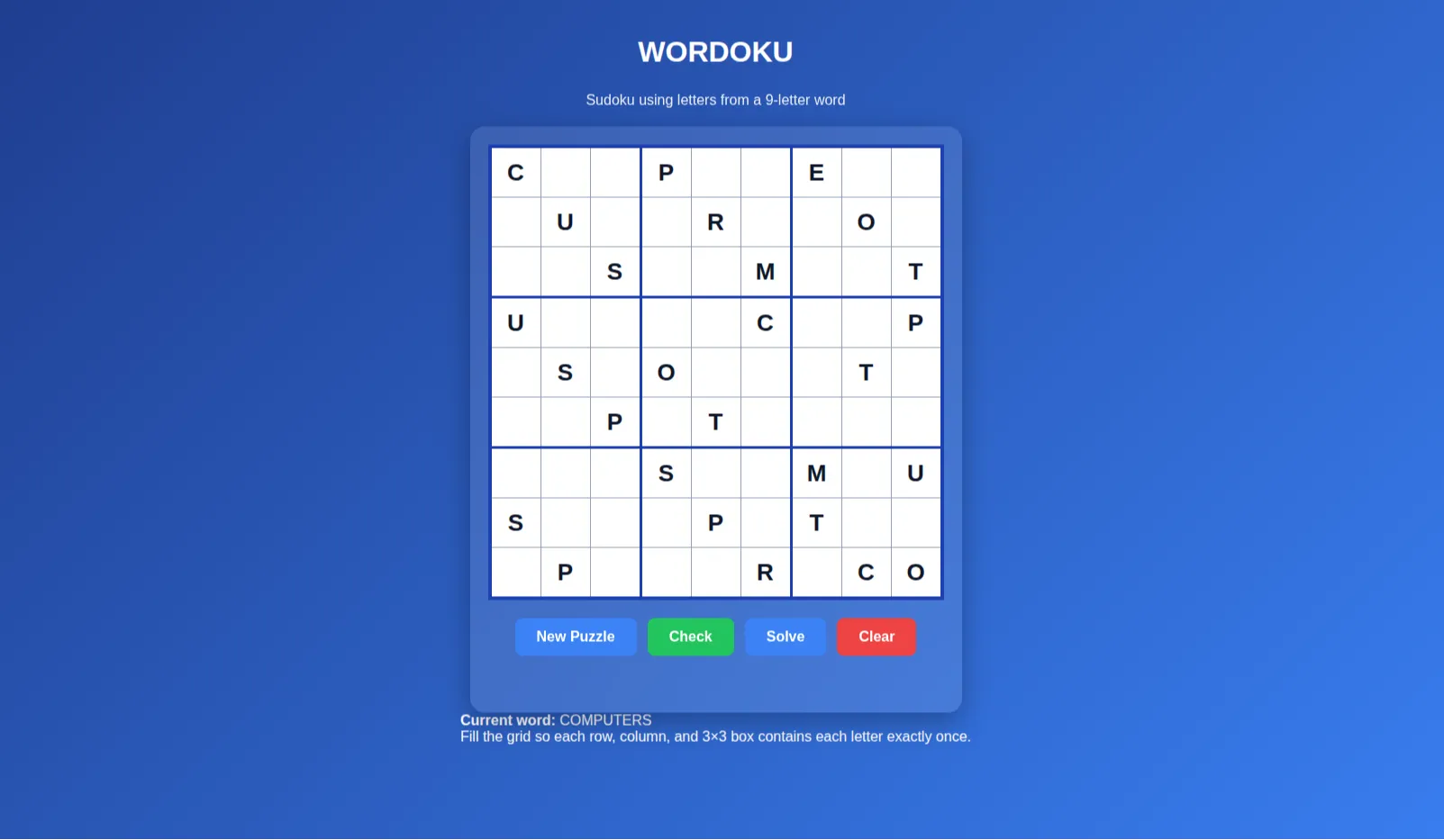
The Wordoku Prototype Game is an engaging frontend project that brings a fresh twist to the classic Sudoku experience by substituting numbers with letters. Designed to challenge both the player's vocabulary and logical reasoning, this browser-based prototype serves as an exceptional case study in complex state management, algorithmic puzzle generation, and advanced DOM manipulation. By combining a mathematically structured UI driven by CSS Grid with rigorous JavaScript validation logic underneath, this project demonstrates how to build a fully functional, highly interactive web game from the ground up without relying on heavy external game engines.
Key Features
- Dynamic Grid Layout: A pixel-perfect 9x9 game board structured utilizing modern CSS Grid, ensuring proportional scaling across all device sizes.
- Real-Time Input Validation: Instant visual feedback that highlights conflicting letters across rows, columns, and 3x3 subgrids as the user types.
- Algorithmic Puzzle Generation: Backtracking algorithms used to procedurally generate valid game states and ensure every puzzle has a single, solvable conclusion.
- Keyboard & Touch Support: Seamless navigation across grid cells using arrow keys, mouse clicks, or mobile touch inputs, coupled with custom virtual keyboards if necessary.
- Game State Management: Built-in functionality for tracking game progression, including timer mechanics, move undo/redo features, and an automatic win-state detection system.
Technologies Used
HTML5, CSS3 (CSS Grid, Flexbox), JavaScript (ES6+, 2D Arrays, Backtracking Algorithms, Event Delegation)
How It Works
The architecture of the Wordoku Prototype Game revolves around a robust JavaScript engine handling a 2D array, which perfectly mirrors the 9x9 HTML grid. When the game initializes, a backtracking algorithm populates the array with a valid 9-letter word and subsequent letters, then removes a specific percentage of them based on the chosen difficulty.
The UI is rendered using CSS Grid, which natively handles the complex visual grouping of the 3x3 sub-boxes without requiring nested HTML tables. As a user inputs a letter, an event listener captures the keystroke and triggers a validation function. This function scans the active row, column, and corresponding 3x3 block in the 2D array. If a duplicate is found, JavaScript dynamically toggles CSS error classes on the conflicting DOM elements, turning them red to alert the player. Once the array is completely filled with no conflicts, the game triggers the victory sequence.
Benefits
For frontend developers, building a Wordoku or Sudoku clone is a rite of passage. It provides invaluable, hands-on experience with recursive algorithms, 2D array manipulation, and keeping complex application state perfectly synced with the DOM. For publishers and educators, integrating logic-based mini-games like Wordoku directly into web platforms dramatically increases user retention, daily active usage, and provides cognitive benefits for audiences of all ages.
Use Cases
- Embedded daily mini-games for digital newspapers and media publications
- Interactive educational tools for spelling and cognitive development
- Brain-training and puzzle web applications
- High-level logic portfolio pieces for software engineering candidates
- Gamified promotional campaigns requiring users to solve a hidden word
Conclusion
The Wordoku Prototype Game is a testament to the capability of vanilla web technologies to handle computationally heavy, logic-driven applications. By mastering the intersection of strict algorithmic validation and responsive UI design, developers can create polished, engaging digital experiences. Whether used as a learning tool to sharpen your JavaScript skills or as a sticky feature for a commercial website, this logic puzzle framework is an outstanding addition to any web repertoire.
Frequently Asked Questions
What is a Wordoku game?
Wordoku is a logic-based placement puzzle identical to Sudoku, but it uses nine distinct letters instead of the numbers 1 through 9. The letters are usually chosen so that a specific 9-letter word is spelled out along the main diagonal or a specific row/column.
Why use CSS Grid for the game board instead of an HTML Table?
CSS Grid offers vastly superior flexibility and responsive control over traditional HTML tables. It allows developers to easily create perfectly square cells, define the thicker borders separating the 3x3 subgrids without complex HTML nesting, and seamlessly scale the board for mobile screens.
How does the JavaScript backtracking algorithm work?
Backtracking is a recursive algorithm that attempts to solve the grid one cell at a time. If it places a letter that eventually leads to an unsolvable state later on the board, it "backtracks" to the previous cell, tries a different letter, and moves forward again. This is used both for generating puzzles and creating automated "hint" solvers.
How is user input handled to prevent invalid characters?
The game utilizes JavaScript event listeners (specifically keydown or input events) to intercept user typing. The script checks if the inputted character matches the allowed 9 letters for that specific puzzle. If it doesn't, the input is programmatically rejected via event.preventDefault().
Can this game be played on mobile devices?
Yes. The responsive CSS Grid ensures the board fits on smaller screens. However, since mobile devices lack a physical keyboard, developers typically implement a custom on-screen UI keyboard featuring the 9 specific letters to optimize the mobile user experience.
Download is Locked
Please scroll down to view the full page and unlock the download link.
Your Download is Ready
Click the button below to retrieve the project source code.
More Related Items by CodeTap
View All